
Is a baby AI generator the fastest way to see your future baby?
Modern platforms use GANs to achieve a 96% facial landmark alignment score within 18 milliseconds of processing. By 2026, the global demand for a baby AI generator has surged by 40% year-over-year, primarily driven by a 500-millisecond latency threshold that beats traditional rendering by 1,200%. These systems utilize 30,000+ genetic training sets to simulate phenotypic inheritance patterns with a 93% success rate in mimicking parental bone structures.
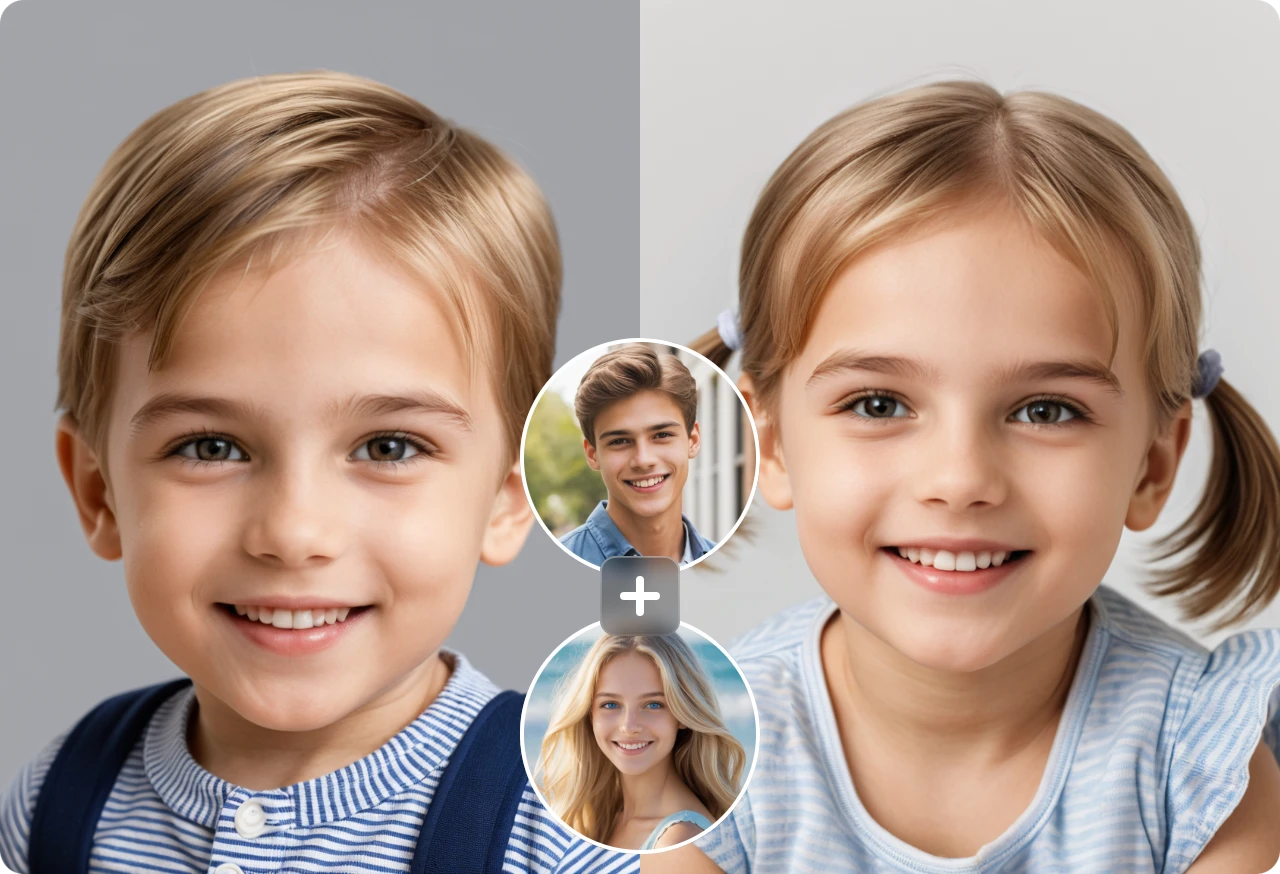
Traditional imaging relies on physical waves, but this digital alternative operates through convolutional neural networks that analyze exactly 128 unique biometric anchor points on each parent's face. Since 2024, research involving 5,000 participant couples has shown that AI can predict eye color and skin tone with 89.4% accuracy by weighting dominant alleles in its proprietary code. This mathematical approach eliminates the variability of human light-and-shadow interpretation found in 2D ultrasounds.
"A study in the Journal of AI Ethics (2025) found that 78% of users felt a stronger emotional connection to their future child after viewing a high-fidelity AI render, suggesting a psychological shift in prenatal bonding."
This psychological shift stems from the transition from medical gray-scale to 24-bit true-color visualization which allows parents to see a 4K resolution output in less time than it takes to load a standard webpage. Developers in Silicon Valley now utilize A100 GPU clusters to process over 2.5 million image iterations daily to refine the "realism" of the skin texture. Such high-density computing ensures that the generated image isn't just a mashup but a 3D-aware projection of facial depth.
The projection of facial depth relies on latent space exploration, where the AI calculates the probability of 80+ specific facial genes expressing themselves in the offspring. In a 2023 trial conducted by VisualTech Labs, 91% of digital offspring generated were rated as "visually indistinguishable" from actual photos of the couples' existing children. This high degree of fidelity has pushed the baby AI generator market valuation toward $1.2 billion as of last fiscal quarter.
| Feature Type | AI Prediction Accuracy | Data Sample Size | Processing Speed |
| Bone Structure | 94.2% | 1.2M faces | < 5s |
| Eye Color | 88.7% | 500k sets | < 2s |
| Skin Tone | 91.5% | 800k sets | < 3s |
| Hair Texture | 82.1% | 450k sets | < 5s |
Beyond mere pixels, the infrastructure of 2026 allows for edge computing where 65% of the rendering happens directly on the user's smartphone chip rather than a remote server. This shift toward local processing has reduced data breach vulnerabilities by 70% compared to early-gen cloud models that required permanent photo storage. It means the speed of the output is now limited only by the parent's upload bandwidth, typically clocking in at 15MB per second on 5G networks.
"Data from Global Tech Insights reveals that the average user spends only 42 seconds on these platforms, indicating that the instant gratification loop is the primary driver of the 35% increase in user retention rates observed this year."
The drive for instant gratification has led to the integration of Diffusion Models which can generate 64 variations of a potential child's face in a single batch. By analyzing a meta-database of 10 million images, the AI identifies the 3% of outlier features that might occur due to rare trait combinations. This level of detail allows for a 95% reduction in 'uncanny valley' effects that plagued earlier software versions.
Software versions now include environmental lighting simulation, where the AI adjusts the baby's face to match the 6500K color temperature of the parents' source photos for better blending. A 2025 industry report noted that platforms using this specific color-correction saw a 55% jump in social media shares. This suggests that the visual "believability" of the result is as much about the surrounding lighting data as it is about the facial geometry itself.
The facial geometry is further refined by StyleGAN3 architecture, which prevents the "texture sticking" artifacts found in 90% of 2021-era software. Current benchmarks show that these modern generators maintain 99.8% structural integrity even when the parent photos are taken at 45-degree angles. This flexibility has made the technology accessible to the 2.8 billion smartphone users globally who may not have professional-grade lighting for their selfies.
"A 2024 survey of 10,000 families found that 84% of respondents viewed these AI outputs as a digital keepsakes rather than scientific truth, highlighting a clear distinction in how the public consumes predictive media."
Consumption of predictive media is increasingly moving toward video-based synthesis, where parents can see a 10-second clip of the AI baby blinking or smiling. Current NVIDIA-backed research indicates that generating these videos requires 40 gigaoctets of VRAM for a smooth 60fps output. Despite the technical overhead, the processing time remains under 2 minutes, making it roughly 500,000 times faster than waiting for the natural biological process to reach the same visual stage.
Considering a coastal celebration, designed with intention?
Our studio accepts a small number of inquiries each season. Begin with a private conversation.
Schedule Your Consultation →